Industry Insights
By DeVry University
May 13, 2023
7 min read


Chat with a live agent now.
 No thanks


May 13, 2023
7 min read
The Internet of Things (IoT) is an interconnected network of physical objects that "speak" to one another using sensors and software. These devices connect over the internet and can be used to transmit data, perform data analysis and control one another remotely.

Let’s explore some common questions related to IoT:
To get a sense of how this works, let’s use a smart home as an Internet of Things example. Imagine a home that features interactive voice assistant apps like Amazon’s Alexa, smart devices such as an Amazon Echo™ or a Google Home™1, a smart thermostat, several smart bulbs and a high-tech sprinkler system. Thanks to the Internet of Things, you can control these devices using voice commands. Many of these devices also have the capability to transmit usage data to your phone through an app. That data can provide a clearer picture of things used in the house like water usage from the sprinkler system, electrical demand from your interior lighting and the amount of time your air conditioning or heating unit spends running. The data gained from these devices makes it easier for people to make informed decisions about how and when they use them.
Of course, the Internet of Things isn't just useful for smart homes, there are several industrial and professional uses for IoT connected devices. In this article we'll explore why the Internet of Things is important, how it was developed and how it can be applied to business environments to improve workflow.

The Internet of Things is important because of its capability to provide both individuals and companies with useful data and analytics. It also increases ease of use by enabling several devices to be simply controlled through a smart phone or via speech commands.
The key benefits of this network of objects can be broken down into three areas — interconnectivity, communication and automation.
This is the core pillar of the IoT. It allows for holistic integration between smart devices and allows the user to control them from one touchpoint.
With an IoT-enabled thermostat, for instance, you can check its status directly from your phone without being in the same room. Interconnectivity is also what allows your fitness trackers, smart appliances, and voice assistants to work and share data seamlessly with each other.
Communication and interconnectivity go hand-in-hand when it comes to IoT. As interconnectivity is about data sharing, communication takes things a step further by allowing devices to speak to and control one another.
Take for instance our smart device example from earlier. With these devices, you can enable voice control to do a variety of tasks, from adding items to your online lists and shopping carts, to setting reminders on your phone or calendars, to turning on lights and much more, all with one or two simple commands.
At the business level, this inter-device communication helps companies to stay ahead of potential problems. Communication between devices can tell users if a piece of equipment requires maintenance before it breaks, allowing the company to service the equipment before it interrupts workflow. These devices can often indicate the exact part of the equipment that is experiencing issues, which can reduce the amount of time a technician has to spend on site finding and fixing the problem.
Because devices are interconnected and capable of communicating with one another, they can often be set to perform certain functions in an automatic fashion.
Returning to our smart home analogy, automation can help you complete your morning routine. With the proper smart technology in your home, you can set your coffee maker to brew and your alarm clock to go off at the same time every morning, helping you keep your schedule consistent.
At the business level, automation becomes even more powerful. Some farmers have found ways to use the Internet of Things to improve the efficiency of their greenhouses. Smart greenhouses can help regulate climate, lighting, air movement, and water usage, allowing plants to grow with less human interaction.
The benefits of IoT applications and their interconnectivity can be seen in many sectors of the global economy, including:
The Internet of Things is something that tech companies have worked toward for decades. The whole concept branches from the idea that adding sensors and artificial intelligence (AI) to devices could improve efficiency and expand the range of services a single device could provide.
In 1999, the British tech pioneer Kevin Ashton coined the term "Internet of Things." He had an idea of a future in which devices were connected to one another in much the same way that people and computers connect with one another via the internet. Now, with huge advances in AI and technology, we have reached a point where it’s easier than ever to create a more robust Internet of Things.
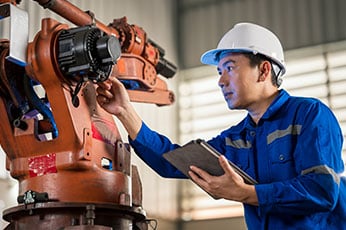
While home IoT can help people in a variety of ways in their own homes, perhaps the greatest demonstration of its power is through industrial Internet of Things applications.
Three ways that industrial IoT helps companies improve their efficiency and gain greater insight into their processes are:
There are several career opportunities for people who wish to work with IoT, including:
1Reference in this publication to any specific commercial product, process or service, or the use of any trade, firm or corporation name is for general information purposes only and does not constitute an endorsement, recommendation or certification of any kind by DeVry University. Persons using such products and services assume responsibility for their use in accordance with the provider’s current terms and conditions.
Filter blog post category